Homeitat Refugia · Ecological Learning Sanctuaries
Author-held project packet, undergraduate research framing, and launch materials developed by Sahar Tai-Seale.
A cooperative civic-design game and immersive bioregional learning environment opening toward skilled making, public requests, stewardship sites, and locally governed development.
Working question
Homeitat begins with the relationship between internal and external stability: how a person develops a home within, a habitable relationship with place, and the practical structures needed to remain connected. The game makes that system playable before a site makes it buildable. A distributed network of a shared workroom, portable kits, schools, partner sites, kiosks, neighborhood nodes, and locally authored worlds could make the inquiry tangible without turning private homes, vulnerable people, or public processes into spectacle.
Work already in hand
Earlier Homeitat Refugia work framed ecological learning sanctuaries as co-designed, interspecies places for regenerative education, arts, land-based pedagogy, and recovery. Research framing connected the idea to the UC Davis Student Farm and Spiral Garden, with attention to disabled, neurodivergent, marginalized, and housing-insecure participants.
The network proposition adds a practical layer: natural-built small homes, stewardship pods, gardens, learning sites, and hosts could remain locally owned while participating in a shared system for visits, skill exchange, documentation, and mutual support.
Product in development
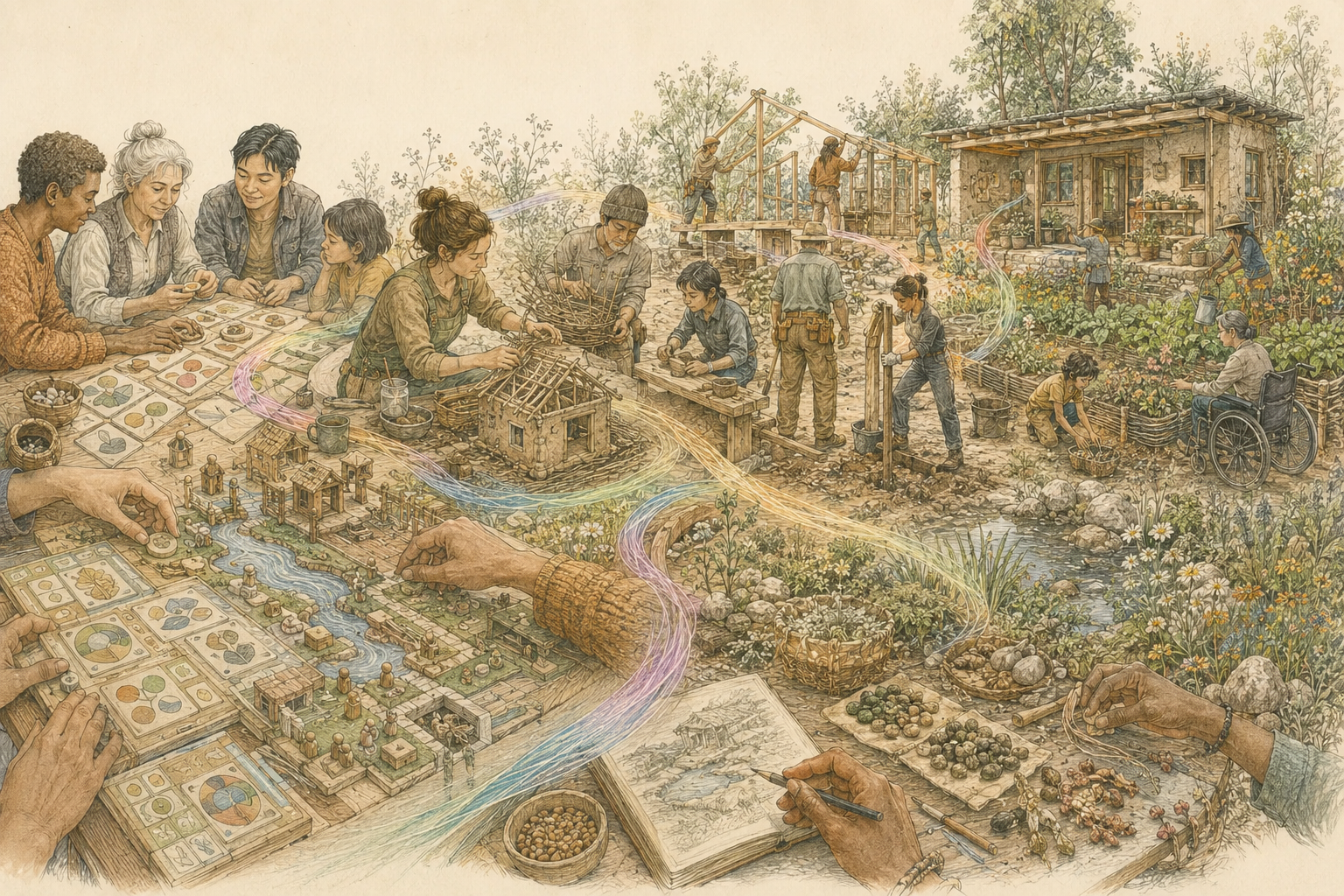
Drawing from tabletop gaming, community practice, game theory, and art as education, Homeitat creates an accessible front door into a complex living system. Cards, tokens, scenarios, maps, and handmade dioramas let participants explore how inner capacity, shelter, ecology, labor, care, resources, boundaries, and belonging interact without requiring a physical site.
At the table, a participant can make a choice, see what it changes, revise it, and try again. That low-risk experience can strengthen locus of control, self-efficacy, confidence, communication, initiative, and the entrepreneurial and professional capacities needed to carry an idea into shared work. Homeitat is a learning environment—not a clinical assessment or a promise that play alone produces those outcomes.
Build the layer
At pocket scale, Homeitat can use cards, maps, local skins, role decks, badges, zines, and printable pieces. At tabletop scale, participants can build a three-dimensional watershed, foodshed, neighborhood, or corridor. At room scale, modular structures, light, wiring, ceramics, soil textures, textile, sound, paint, plants, projection, and loose parts can make ecological and economic relationships spatial, sensory, and revisable.
This is live-action civic sculptural art and experiential education: a group can move through the system it is studying, notice whose route is blocked, see how water, food, work, care, mobility, culture, habitat, and exchange braid, and revise the layer before any claim is made on a real site.
A shared system with local authors
Individuals and civic or community groups could buy, make, or bring their own skins, swag, game pieces, rule variants, textures, signs, stories, and modules. Credited local adaptations could create roles for people working in wiring, wood, ceramics, soil and pedology, paint, textile, planting, mapping, model-making, zines, food and water systems, access, facilitation, documentation, repair, and care.
A multi-stakeholder cooperative could hold shared standards and mission-locked stewardship while local groups retain authorship and benefit from what they make. The legal architecture still needs specialist counsel: cooperative form alone does not automatically prevent demutualization, acquisition, extraction, or uncredited reuse.
Karma Kiosk · public process interface
A kiosk could explain the application and approval path, show requirements and status, connect a person to assistance, and issue three different records: a pending navigation receipt, an active-work badge or vest insert after real authorization, and a completion or stewardship record after review.
An active credential would need to name the actual issuing authority, project, site, task, role, supervisor, permit or work-order reference, validity window, required training or equipment, and a QR link to the current record. Homeitat would never turn a self-printed badge into a City employee identity, a blanket permit, or permission beyond the named scope.
A civic partnership—not premature ownership
Businesses, districts, schools, public agencies, community groups, and site hosts could submit bounded development or stewardship requests through one accessible front door. Homeitat could help map the affected ecology, applicable requirements, people and roles, local assets, prototype options, sponsorship, and next handoff.
A City or other public body would retain authority for permits, inspections, public safety, procurement, employment, and public-space use. Homeitat could remain an independent, mission-locked civic design and learning cooperative that is funded, hosted, or contracted for a defined pilot rather than becoming a City-owned platform before the method and governance have been tested.
From hand to habitat
Homeitat moves deliberately from fine-motor imagination toward gross-motor practice. People can rehearse design, facilitation, cooperation, and consequence at tabletop scale before the stakes include heavy materials, land, money, housing, or long-term agreements.
Connected practice
The game is not expected to become a housing, training, cultural, agricultural, and governance program by itself. Each connected practice has a distinct responsibility in the pathway.
Lineage before branding
A responsible Homeitat record would name the actual building method, teachers, builders, cultural and technical lineages, local adaptations, permissions, and code context. SuperAdobe, cob, and cob-learning work associated with Miguel Elliott / Sr. Cobb A Lot should remain distinct rather than being flattened into one invented house style.
Möbius can contribute coordination, learning agreements, resource mapping, stewardship tools, and documentation. It should not claim authorship of building traditions or represent a host’s home as a network asset without consent.
The atlas
Hosts could voluntarily register an existing build, a work in progress, a garden, a demonstration site, or a future project. Each record could describe method, climate, stage, access, needs, learning offers, Five-Element observations, garden systems, and the relationships the host is willing to receive.
A supported path to inhabitation
One possible application would connect a future resident with a small, permitted home while it is being financed, designed, and built. A personal contribution toward the home might be combined with social-service assistance, scholarships, sponsorship, or stewardship funds.
During that period, the resident could join accessible, compensated, or otherwise clearly recognized learning and co-building opportunities through Homeitat, Baile, Farmers Matrix, and AACDI. By move-in, the resident would not be entering an unfamiliar structure surrounded by strangers: the home, support network, working relationships, maintenance plan, and boundaries would have been developed together.
Care and agency
The purpose is not to test whether someone has enough work ethic to deserve a home. It is to create enough time and structure for residents, hosts, builders, facilitators, and partner organizations to demonstrate mutual reliability—and to identify what support makes participation possible.
A first build
A credible pilot would begin with one willing host or intended resident, one authorized site, a real need, a named building lead, permit and safety review, a fundable budget, accessible participation options, and a clear post-build stewardship agreement.
The build could test whether fundraising, skilled teaching, volunteer participation, paid labor, garden design, Five-Element observation, documentation, and later visits can coexist without exploiting the resident, builder, or people who help.
Independence, lineage, and future form
This is an independently developed working concept stewarded by Sahar Tai-Seale. It has been cultivated through interdisciplinary study, field observation, and reciprocal learning with people bringing diverse lived-experience perspectives across communities, institutions, movements, and traditions of cooperative practice. No single organization, institution, industry, or community is presented as its sole origin, owner, sponsor, or endorsing body.
The work invites participation, study, critique, contribution, and thoughtful adaptation while respecting authorship, intellectual lineage, consent, and the contributions of others. Openness does not mean permission for extraction, institutional absorption, or uncredited reproduction.
At present, Homeitat is part of a grassroots initiative and emerging form of community infrastructure—not a formally incorporated organization or an adopted program of any organization. With accountable governance and adequate legal, financial, housing, planning, design, and land-stewardship support, the work may eventually establish, support, or partner with a community land trust, cooperative housing organization, nonprofit, fiscal sponsor, or another structure consistent with its values. Its final institutional form should emerge through bounded pilots and demonstrated needs rather than being predetermined.
Sources and material in hand
External sources remain linked and distinct. Author-held materials are named without implying that every underlying document is publicly released.
Author-held project packet, undergraduate research framing, and launch materials developed by Sahar Tai-Seale.
Prior system studies connecting housing, agriculture, transit, rest nodes, ecological learning, member lodging, and stewardship exchange.
A current local process used here as a governance analogy: interest form, application and checklist, design standards, insurance, license execution, renewal, and program learning. Homeitat is not part of this City program.
Open sourceCurrent invitations
Claim and care boundary
Homeitat is a product and practice in development—not an adopted City program, permit portal, public credentialing authority, employer, or source of permission to work. It does not currently offer a released game, housing, approved construction plans, licensed design or engineering, land access, insurance, financing, or public visitation. Participation must be consent-based and accessible in more than one mode; housing security must not be casually conditioned on attendance, physical labor, unpaid contribution, disability status, or continued program participation. Specific people and private homes remain unnamed unless they knowingly choose public participation.