Place and conditions
Observe water, soil, light, habitat, access, infrastructure, contamination risk, maintenance history, and existing use before prescribing a program.
People listen to the land, grow food and habitat, share tools, and return the harvest fairly.
Farmers MatrixCultivate place. Cultivate society. An agricultural and material development stream connecting land, food, water, habitat, maintenance, trades, and ecological operations.
Working premise
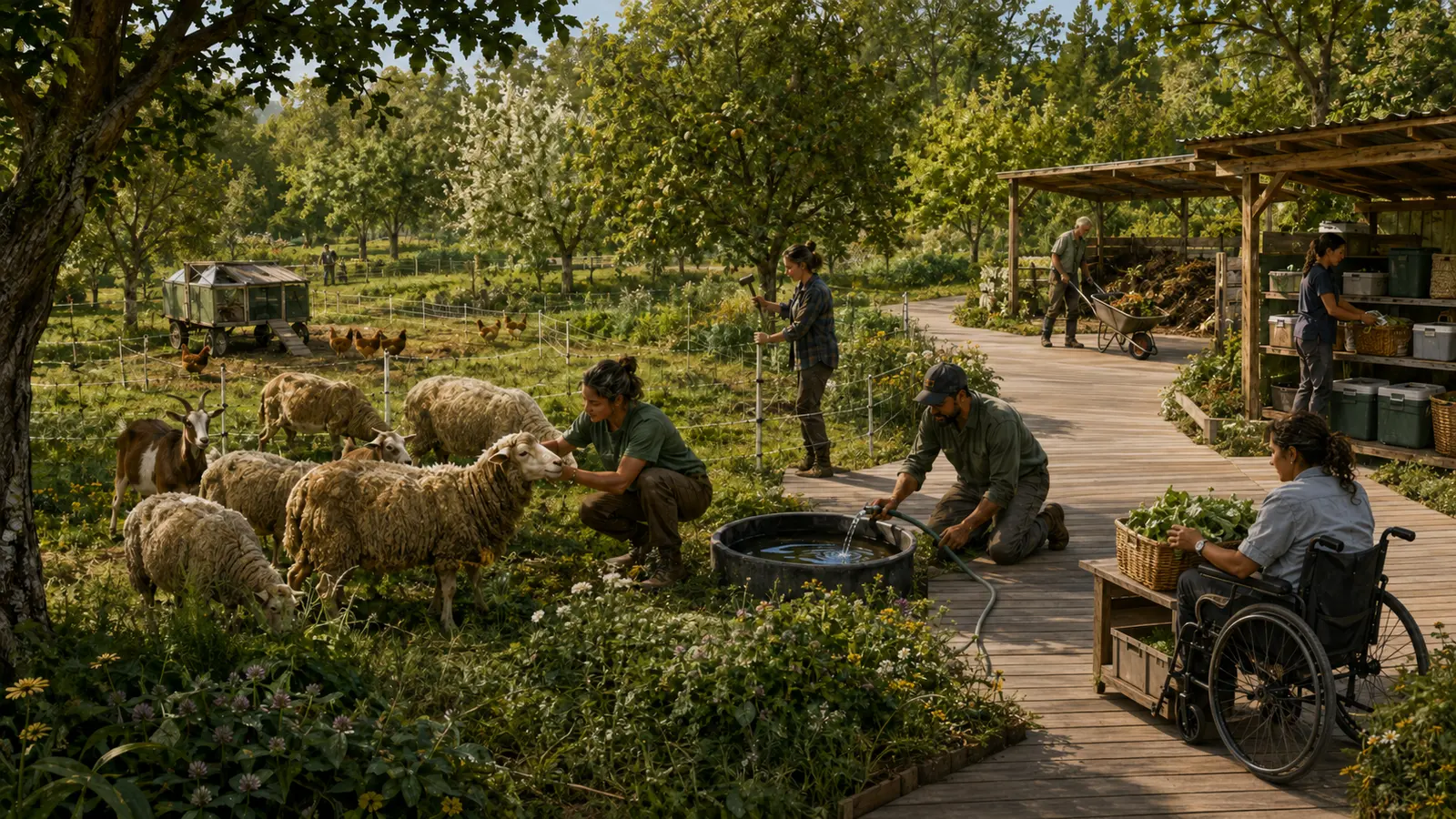
Farmers Matrix treats food and land practice as a living relationship field. Rather than beginning with a program brand, it begins with conditions: who knows the place, what is growing, what is constrained, where resources move, whose labor remains invisible, and what forms of cultivation a site can responsibly sustain.
Different visual doorways
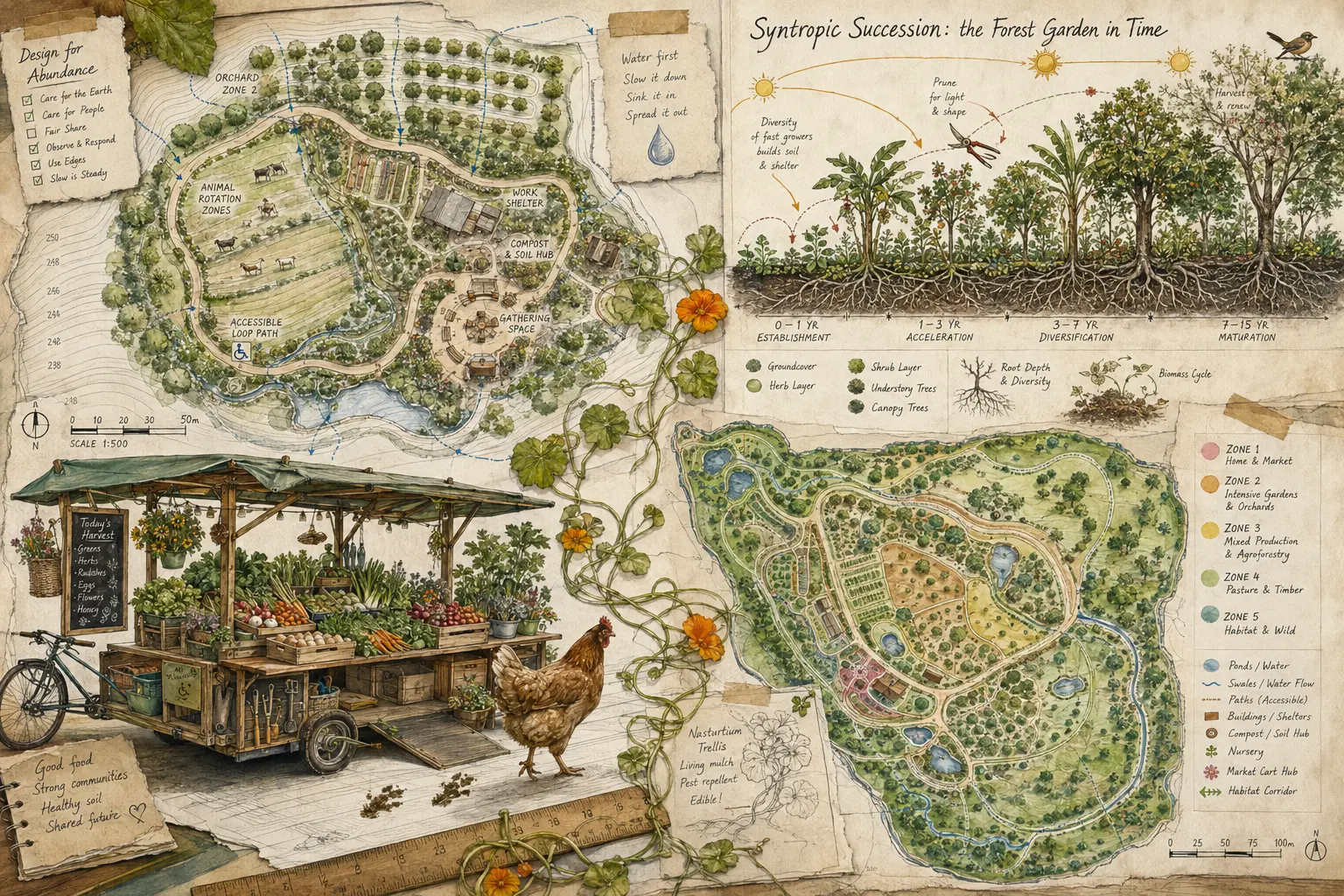
Each image holds a different scale, mood, or practice. Together they keep the project from collapsing into one scene.
Restoration Commons · Farmers Matrix’s role
A community member should not need a university affiliation to learn restoration ecology or contribute to a local landscape. Farmers Matrix can organize day-sized, host-approved work for neighbors, travelers, people between housing or jobs, students and nonstudents, families, elders, and disabled participants—with training, choice, supervision, fair return, and a clear finish.
See only pre-reviewed tasks and events: shade and soil-cover work, habitat observation, watering, mapping, litter removal, propagation, or site-approved foxtail and invasive-plant management that protects animals without treating every plant as waste.
Pick a task by interest, access need, skill, time, or energy. A playful ‘surprise me’ draw can offer serendipity among suitable options, but reshuffling or declining is always allowed and nothing has monetary stakes.
Complete the relevant micro-training, confirm the actual site authority, check tools and conditions, receive a time-limited task record, follow stop-work rules, and work with qualified supervision where the ecology requires it.
Record observations and completion, return tools, identify maintenance needs, and provide the promised return—pay, stipend, time credit, meal, training, produce, or another lawful and explicitly agreed benefit.
The access-and-labor boundary
A restoration weekend may be paired with separately authorized camping or short-stay access through Homeitat, Refugia, or a participating host. The stay is not the wage: shelter, safety, or permission to leave must never depend on finishing unpaid labor. Participation is voluntary, harm-reduction-informed, and not a sobriety or moral-worth test.
Farmers Matrix · manual annotation key
These symbols can tag maps, cards, checklists, work orders, and public-learning materials. Every mark stays paired with its level number and words, so color is never required to decode it.
Fourfold World · What belongs where?
Pentad · What affects what?
Hexagon · How do we cooperate?
The sequence links agriculture, habitat, tools, trades, maintenance, art, teaching, and accountable handoff rather than reducing Farmers Matrix to planting alone.
Evidence in hand
A named project can orient development without pretending that a complete program, host, cohort, site, or institution already exists.
Practice rooms
These are working areas for learning, review, collaboration, or a future bounded pilot—not departments with unlimited scope or standing authority.
Observe water, soil, light, habitat, access, infrastructure, contamination risk, maintenance history, and existing use before prescribing a program.
Connect propagation, plant and food knowledge, local history, stewardship records, and appropriate specialist review.
Make cultivation, care, coordination, teaching, harvesting, distribution, and maintenance visible enough to resource and credit.
Decide how food, materials, learning, revenue, seed, tools, and ecological benefit return to participants, place, and future cycles.
Current invitations
Claim and care boundary
Farmers Matrix is not represented as a farm, current food-distribution program, or substitute for agricultural, environmental, public-health, or land-use expertise. Site claims require permission, specialist review where appropriate, and clear agreements about risk, labor, food safety, access, records, and benefit.