Arrive for the day
Use the public garden corridor, café or co-op shop, toilets, water, shade, seating, Commons Kiosk, open school, or a low-barrier event without joining a residence program.
ARCS is a founder-authored concept for a small, permitted, accessible, low-impact garden-and-learning corridor where shelter or seasonal camping, sanitation, cooperative workspace, ecological training, public culture, and everyday respite can support one another instead of being designed as separate emergencies.
South Davis, Willowbank, Mace, and the Grasslands edge are a study geography—not a claimed parcel. No land, permit, campsite, funding, operator, or opening date is represented.
The working proposition
Start with one site, one season, reversible structures, a small operating team, resident and community review, and a public decision about what deserves another cycle.
A person might come for a restoration weekend, a structured day between jobs or leases, a local respite trip, a café shift, a garden lesson, a movement practice, paid site work, a cooperative meeting, or simple curiosity. The center offers direction without turning poverty, disability, housing status, sobriety, productivity, or performed gratitude into a test of belonging.
Three doors · no compulsory ladder
The routes may overlap, but none should quietly become the price of another. A resident may decline restoration work. A volunteer does not gain an implied right to camp. A day visitor does not need to become a member.
Use the public garden corridor, café or co-op shop, toilets, water, shade, seating, Commons Kiosk, open school, or a low-barrier event without joining a residence program.
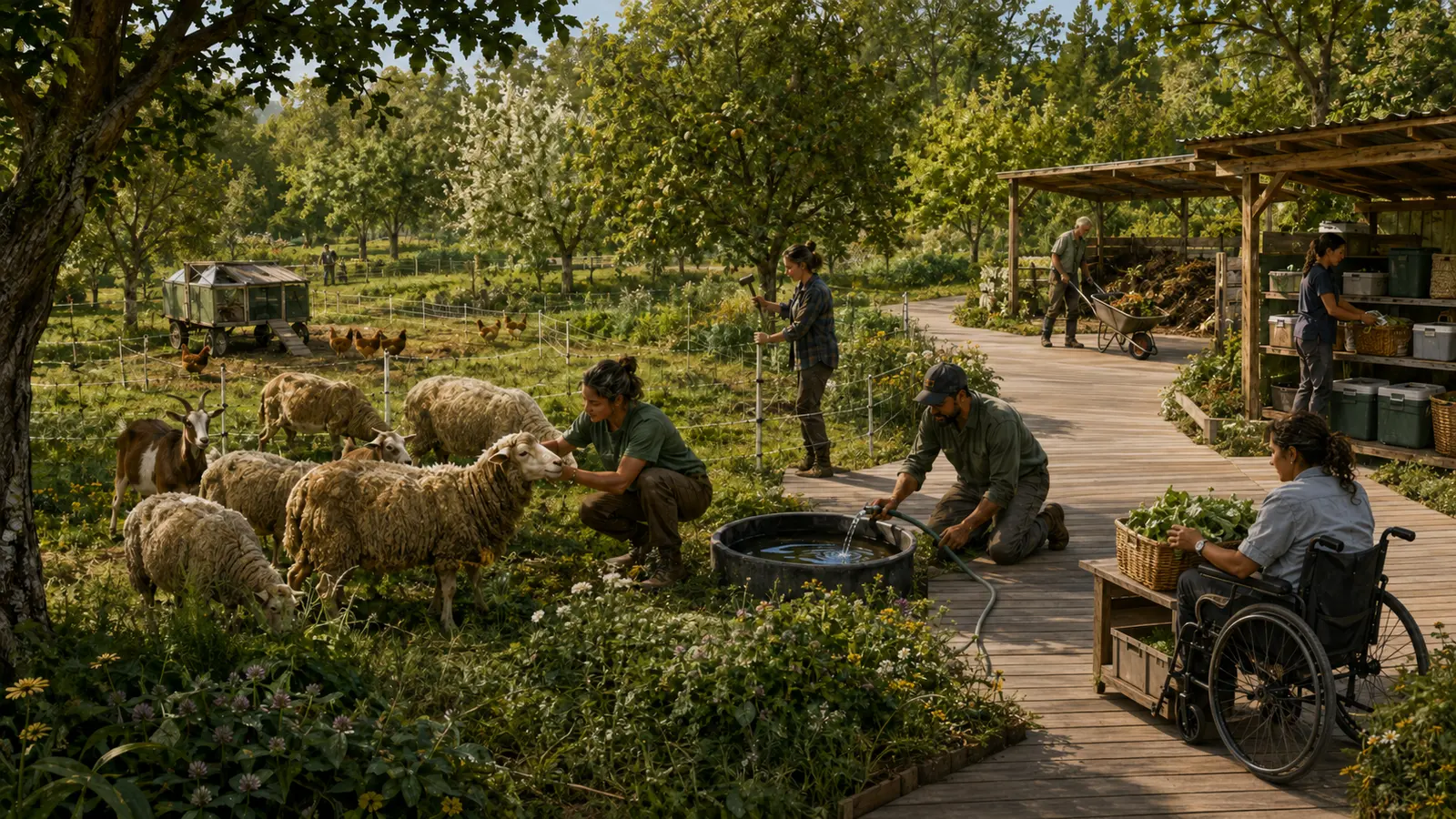
Choose a host-approved restoration, mapping, craft, movement, food, repair, accessibility, documentation, or teaching role—with orientation, choice, supervision, credit, and a clear finish.
Where lawfully authorized, a person could enter a seasonal shelter or camping pathway with privacy, storage, sanitation, safety, quiet, accompaniment, and exit rights. Rest is not wages and housing is not earned by labor.
The non-coercion floor
No generic work-for-shelter bargain. Shelter, water, toilets, safety, and the right to leave do not depend on completing unpaid labor. Necessary operating work should be paid; volunteer service should be optional, bounded, and truthfully labeled; resident participation in governance should be supported rather than extracted.
One center · several distinct systems
Each program keeps a different job. Their connection is operational: a person can arrive, orient, choose, participate, rest, be credited, and return without one kiosk or organization pretending to hold every authority.
Make the agreements, kiosk, maps, stories, workshop, and natural-built threshold inhabitable.
Carry ecological task decks, tools, training, supervision, site records, fair return, harvest, and maintenance.
Make permissions, roles, scenarios, badges, check-in, handoff, and bounded civic learning legible.
Offer embodied learning, sound, solitary and group movement, rest, festivals, and accessible movement corridors.
Hold sanctuary, navigation, privacy, accommodations, recovery, accompaniment, and more than one route back.
Help each person locate a next step without pretending everyone begins with the same capacity or support.
Become the hospitable botanical threshold: café, tea, plant learning, arrival, pause, and connection.
Bind the rooms into one seasonal, regional learning center with public oversight and a documented return.
Minimums before invitation
Temporary or natural-built structures can reduce footprint and make a seasonal pilot reversible. They do not remove obligations around land authority, disability access, fire, sanitation, labor, public health, environmental review, privacy, insurance, neighborhood effects, or safe closure.
A named landholder or host, lawful site authority, and a written scope with opening and closing dates
A firm, stable, slip-resistant accessible route connecting arrival, toilets, water, shelter, work, shade, and emergency access
Working drinking water, handwashing, toilets, waste service, food-safety boundaries, and a maintenance schedule
Weather-appropriate shelter, cooling and shade, storage, quiet, lighting, fire planning, and a safe-night protocol where overnight use is authorized
Qualified ecological plans and technical leads defining approved tasks, no-work areas, stop-work rules, tool controls, and habitat protections
Paid coordination and clearly labeled paid, volunteer, learning, exchange, and resident roles—without making shelter, dignity, or safety conditional on productivity
A privacy-minimizing check-in, consent and conduct agreement, confidential complaint path, emergency response, appeal, reassignment, and exit
Insurance, disability-access review, labor and public-health review, neighborhood communication, a closure plan, and resources to restore or move the site
Access begins with the ground
Loose mulch alone is not automatically wheelchair accessible. The first route must be firm, stable, slip-resistant, low-slope where feasible, wide enough to pass and turn, drained, shaded, and linked to rest. Stabilized natural surfaces, boardwalks, transfer points, and future all-terrain mobility equipment can be studied with disabled users and habitat specialists; mobility technology should not become an excuse to leave the base path unusable.
Sample programming · twelve-week learning season
A one-month prototype could use the same sequence at smaller scale. The point is not to keep a camp open by momentum; it is to test a bounded public-purpose proposition and leave evidence for a transparent next decision.
Confirm the host, legal route, site baseline, access audit, ecological authority, resident and neighbor advisory roles, privacy rules, budget, and stop conditions before inviting participation.
Install only reversible, permitted infrastructure: accessible circulation, sanitation, water, shade, tool control, storage, wayfinding, quiet, first aid, and a staffed Commons Kiosk.
Run day-sized learning, paid work, optional service, restoration, gardening, food, sound, movement, repair, café, and public-review programming. People may attend without staying or working.
Close task loops, pay and credit people, report ecological and access findings, review complaints and incidents, decide what should stop or change, move what is temporary, and publish a bounded pilot record.
A sample day board
The Commons Kiosk can show pre-reviewed restoration, access, garden, craft, café, movement, mapping, meeting, rest, and public learning options. A “surprise me” button may add play without gambling: no money, no penalty, no forced assignment, and a person can reshuffle, observe, rest, or leave.
Day programming may be low-barrier and open without public identification. Overnight use, paid work, regulated tasks, tool checkout, and emergency responsibilities require the minimum confidential information set by the actual host and law—not a public membership roll.
KPI minimums + learning measures
Combining gate metrics and outcome metrics would let a charming event hide unsafe basics. They stay separate.
Opening gates · must pass
Learning measures · report honestly
A public-asset question
Before publicly stewarded land or buildings become high-end private workspace, the public should be able to see the housing, shared-use, stewardship, and mixed-purpose alternatives that were considered.
On August 17, 2026, the Presidio Trust announced a lease of an approximately 40,000-square-foot former barracks—vacant since the early 2000s and rehabilitated over 18 months—to CANOPY for a members-oriented coworking hub. The Trust also states that leasing revenue supports the park. Both facts matter.
This does not prove that the building could legally, financially, or physically have become housing, and ARCS is not a feasibility claim about that property. It does support a broader policy prompt: before an exclusive commercial use is selected, publish a transparent housing and community-benefit alternatives analysis—and test whether residents, workers, public learning, and park stewardship can share the asset.
Precedents to study · not models to copy
The research task is to learn from each precedent’s real governance, financing, labor, access, housing, ecological, and institutional conditions—not collage their nicest features into a promise.
The Presidio already offers drop-in and ongoing habitat, forest, nursery, and maintenance stewardship. ARCS asks how a similarly legible doorway could pair with local learning, respite, and stronger public-benefit infrastructure.
Presidio volunteer programs ↗Tides Converge places nonprofit work, public galleries, food, and shared space in a former Army hospital campus—useful evidence that historic property need not choose only one public purpose.
Tides Converge ↗Scattergood Friends School describes its farm as a place for soil health, food, community connection, research, and hands-on learning. It is a school precedent to study, not an ARCS template or endorsement.
Scattergood Farm ↗Pendle Hill’s Quaker residential programs braid learning, community, work, and worship. ARCS would require a different public, legal, housing, access, and governance design, but the residential-learning rhythm is relevant.
Pendle Hill residencies ↗Concept boundary + next credible move
A community group can author the concept, convene the review, and help operate a program. It cannot grant itself land, suspend a camping ordinance, issue ecological permission, or guarantee the behavior of every participant.
A Davis test might explore a temporary-use permit, sanctioned camping program, special agreement, or separately authorized pilot; the lawful path must be determined with the governing body, landholder, counsel, public-health and fire officials, disability reviewers, ecological leads, affected residents, neighbors, and—where relevant—Tribal consultation. Repeal or amendment of an ordinance is a legislative decision, not a kiosk feature.
The next credible move is a funded feasibility table: City and landholder representatives, unhoused and formerly unhoused people, disabled residents, restoration ecologists, parks staff, housing advocates, neighbors, labor and public-health reviewers, and a potential operator scoping one movable one-month pilot with a real closure budget.