Cooperative civic design · immersive learning · community development

In Development

Homeitat

Build a place you can touch. Play its choices together. Carry one supported move into real life.

Homeitat

Playable civic design + place practice

Read the technical one-sentence description

Homeitat is a cooperative civic-design game and learning environment that moves from cards and dioramas to immersive bioregional layers, bounded site pilots, and locally stewarded development.

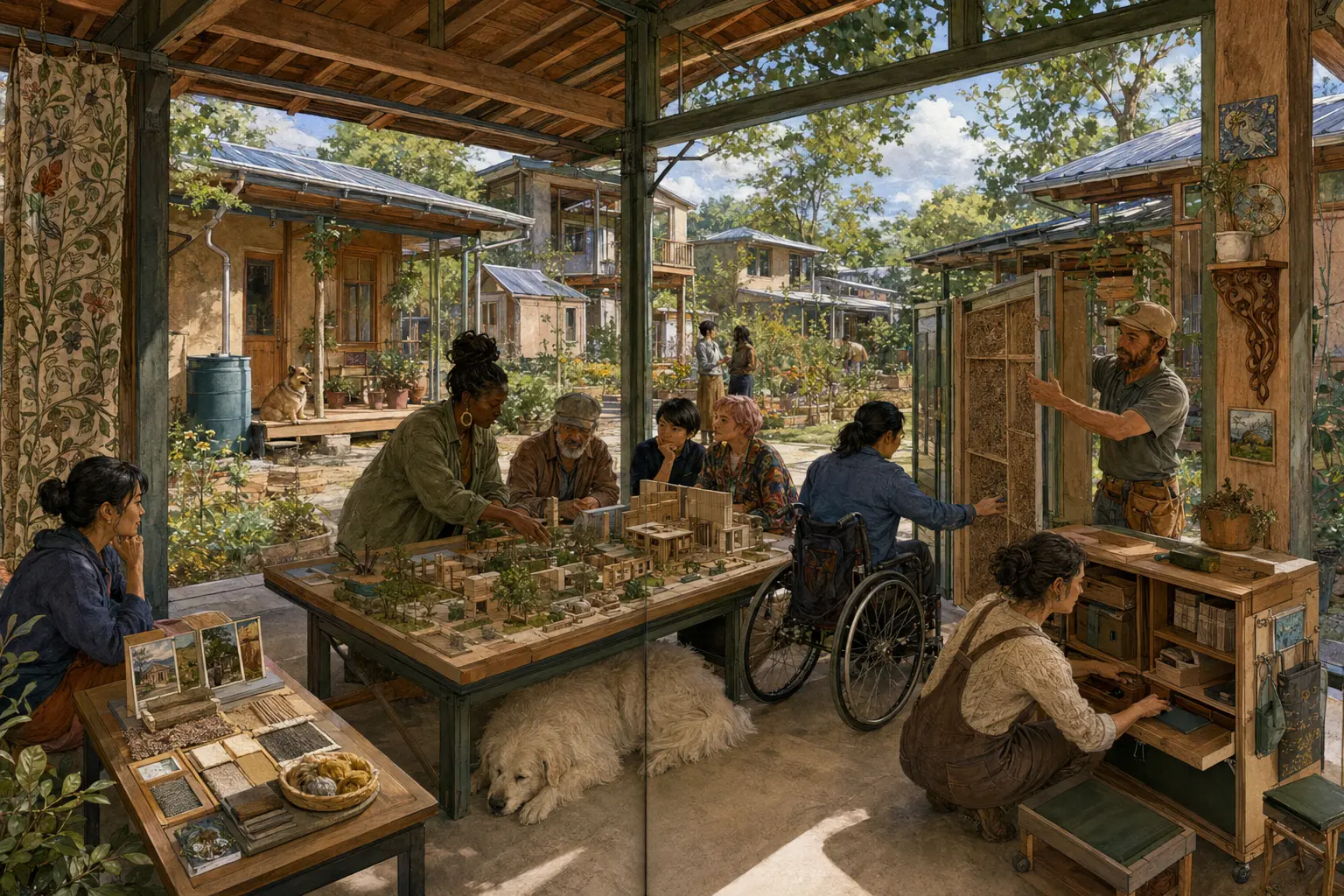
Storybook illustration of an inclusive group gathered around a detailed tabletop landscape, cards, small buildings, tools, plants, and shared materials
Homeitat makes a large living system small enough to touch: move the pieces, notice who is missing, try a choice, and revise it together.

Working premise

What this project holds.

Homeitat joins home and habitat as a playable method for community-based design and development. Cards, scenarios, maps, models, handmade dioramas, and room-scale bioregional layers make watersheds, foodsheds, shelter, mobility, care, culture, ecology, labor, and exchange visible enough to move, discuss, test, and revise. The aim is not single-issue organizing or a technology platform that replaces place. It is an accessible path from imagination and rehearsal into relationships, stewardship cycles, skilled making, public learning, and carefully governed real-world action.

Different visual doorways

More than one way into the idea.

Each image holds a different scale, mood, or practice. Together they keep the project from collapsing into one scene.

Hand-drawn scene moving from a cooperative tabletop game and small home-and-garden diorama toward shared craft, full-scale building, and ecological landscape stewardship
From tabletop to landscapeA model becomes a conversation; the conversation becomes a careful real-world test.
Storybook scene of people passing learning, materials, tools, and care from one community project to the next along a colorful Möbius path
One project helps the nextPeople move through Möbius. Projects move through Oiko Ways. Learning returns to the commons.

Homeitat™ · participatory civic learning method

Build it small. Practice together. Carry it into life.

Cards, roles, maps, handmade dioramas, and room-scale bioregional layers turn an abstract civic system into something people can touch, enter, question, repair, and revise together before the stakes become concrete.

Radial structure · shared with Baile

Read by zone, not rank. Homeitat follows changing loci of choice, negotiation, authority, and accountability across body, room, site, neighborhood, institution, and ecology. Nested scale does not determine human worth.

  1. 01Make a small world

    Choose a room, watershed, foodshed, corridor, service, garden, or neighborhood and give it a shape people can move.

  2. 02Read the living field

    Place people, water, food, shelter, movement, ecology, care, culture, work, exchange, access, and time in relationship.

  3. 03Play roles + conditions

    Add goals, boundaries, permissions, barriers, supports, resources, user agreements, consequences, and repair paths.

  4. 04Build the layer

    Translate selected relationships into an immersive modular landscape people can enter, sense, make, test, and revise.

  5. 05Carry one bounded move

    With a real host, authority, resources, technical review, and safeguards, take one learning into a place-based pilot.

01Explore02Learn03Practice04Cross-train05Contribute06Collaborate07Co-create08Steward09Lead10Co-own

People move through Möbius.Projects move through Oiko Ways.

Build the layer · from card to corridor

One world, four physical scales.

Homeitat is more than a paper tabletop game. Each scale makes a larger relationship tangible while keeping the next step bounded, voluntary, and reviewable.

01

Pocket + print

Cards, role decks, local skins, badges, zines, maps, and printable pieces make the system inexpensive to enter, carry, translate, and remix within shared agreements.

02

Tabletop bioregion

A three-dimensional watershed, foodshed, neighborhood, or corridor makes water, food, shelter, movement, ecology, care, culture, work, and exchange visible at once.

03

Immersive layer

A room-scale modular landscape can combine structures, wiring, light, ceramics, soil textures, textiles, sound, painting, projection, loose parts, and accessible movement.

04

Corridor + site

Only with a willing host, real authority, funds, technical leads, permits, safeguards, and compensation does one relationship become a bounded workshop, stewardship action, or built pilot.

Distributed access · rooted in place

One hearth. Many pathways.

A flagship workroom can make the practice visible without turning Homeitat into a centralized technology company. The network grows through locally governed places, tools, skills, and return paths.

01

One hearth

A future Homeitat Commons can be a public workroom, model shop, kit library, salon, request desk, small maker marketplace, training room, and visible home for the evolving method.

02

Many pathways

Portable kits, schools, design studios, community rooms, partner sites, events, kiosks, and neighborhood nodes let participation travel without making one building or one app the center of everything.

03

Digital back to physical

The website and kiosks help people find requests, standards, roles, schedules, approvals, tools, learning, and return paths. Their job is to route people toward real relationships and places—not replace them.

04

A protected commons

The intended legal design is a multi-stakeholder cooperative with mission-locked stewardship of the name, method, standards, and shared assets so no single buyer, sponsor, platform, or local group can quietly absorb the whole system.

Shared system · locally authored worlds

People can make the place recognizably theirs.

Individuals and civic or community groups can buy, make, or bring their own skins, swag, cards, figures, rule variants, role decks, signs, textures, stories, and place-based modules. A shared license and attribution system can protect local authorship while keeping the core mark, accessibility floor, safety boundaries, consent requirements, and anti-extraction purpose intact.

That naturally creates visible roles for people working in wiring, lighting, wood, ceramics, soil and pedology, paint, textiles, planting, mapping, model-making, zines, food and water systems, access, facilitation, documentation, repair, and care. Local customization is not decoration around the project; it is part of how local ecology and economy braid.

Karma Kiosk · permission made legible

A badge should point to authority. It should never invent it.

The kiosk can help a person understand and move through a permit, license, training, or work-order process. It may print an active work badge or vest insert only when the actual issuing authority has approved a defined scope. Pending is not approved, and a Homeitat credential is not a City employee ID.

  1. 01

    Submit a request

    A business, district, school, community group, public agency, or site host describes a place, need, affected people, desired outcome, timing, resources, and authority already in hand.

  2. 02

    Map requirements

    The request desk identifies the actual owner, host, permitting body, applicable codes, insurance, accessibility, labor, safety, professional scopes, review steps, and missing decisions.

  3. 03

    Approve a bounded scope

    The real issuing authority—not the kiosk—approves a permit, license, work order, site agreement, training role, or other defined authorization for a particular place and time.

  4. 04

    Issue the right record

    Pending requests receive a navigation receipt. Approved work can receive a QR-linked badge or vest insert. Finished work receives a closeout and stewardship record after review.

  5. 05

    Work + close the loop

    Participants check in, follow supervision and stop-work rules, document what happened, repair problems, verify completion, return tools and learning, and let the credential expire.

Pending

Navigation receipt

Shows the request, application number, next step, requirements, help contact, and status. It explicitly says that it does not authorize work.

Approved + active

Work badge or vest insert

Shows the issuing authority, project, site, task, role, supervisor, permit or work-order reference, validity window, safety requirements, and a QR link to the current record.

Reviewed + closed

Stewardship record

Shows what was completed, who verified it, hours or contribution credited, maintenance or return duties, learning captured, and whether any follow-up remains.

Recommended civic structure

City-supported—not City-owned first.

Homeitat can remain an independent, mission-locked civic design and learning cooperative while a City, school, district, agency, business association, or community institution funds, hosts, or contracts for a defined pilot. Public bodies keep their legal authority over permits, inspections, employment, public safety, procurement, and the use of public space.

Businesses and areas could submit development or stewardship requests through a common front door. Homeitat would help make the request visible, map requirements, convene affected people, prototype options, recruit qualified roles, and document the handoff. It would not approve its own permits or imply that every community idea has already become public policy.

Participation agreement · peace with practical edges

Only clear, nonviolent participation keeps the commons usable.

Clear participation does not mean sameness, compulsory calm, perfect speech, or disclosing private information. It means that conduct, authority, risk, consent, and repair are legible enough for people to participate safely.

Consent + conduct

No violence, threats, harassment, hate, retaliation, coercion, sabotage, or unsafe work. People may pause, decline, leave, or ask for another participation mode.

Scope + authority

Every task names who authorized it, where it applies, what it includes, what it excludes, who supervises it, and when the authority ends.

Access + care

Offer more than one route into learning and contribution. Do not condition belonging, housing, care, or dignity on unpaid labor, physical ability, disclosure, productivity, or performed gratitude.

Labor + recognition

Name whether a role is paid, volunteered, exchanged, taught, sponsored, or credited. Make ownership, attribution, privacy, information use, and benefit visible before contribution begins.

Stop + repair

Give participants and technical leads a usable stop-work path, incident response, repair process, appeal, reassignment, and exit without pretending every conflict can or should be reconciled.

New public project room · overnight commons

Camp energy. Adult operating structure.

Explore the proposed Homeitat family of safe-parking, stewardship-sleepover, shared-living-practice, and future hospitality pilots.

The public proposal makes the joyful part visible alongside the unglamorous pieces that keep joy from becoming chaos: consent, privacy, paid staffing, distinct permits, quiet and support zones, graduated response, emergency thresholds, and review.

No body cameras. No shadow case files. No unpaid labor required for rest. No pilot opens merely because the concept is charming.

Vision → praxis map

Protect the seed. Test the method. Grow only what can be governed.

The sequence keeps the immediate work small enough to finish while holding the longer horizon of a storefront commons, design-school partnerships, public contracts, and distributed cooperative stewardship.

  1. 01

    Protect + record

    Archive the founder edition, clear the Homeitat mark, register protectable expression, and establish contributor, local-adaptation, privacy, credit, and licensing agreements.

  2. 02

    Prototype for 90 days

    Raise a $25,000 starter budget for one playable kit, three to four facilitated workshops, participant access, documentation, evaluation, and a visual pilot-and-funder report.

  3. 03

    Open a temporary hearth

    Test a pop-up workroom or partner storefront with a kit library, immersive build, public salon, maker roles, request desk, and clearly bounded hours, access, labor, and safety agreements.

  4. 04

    Partner without surrendering

    Invite design schools, educators, makers, community groups, businesses, districts, and public agencies to bring requests, review the method, sponsor access, host pilots, or contract for defined work.

  5. 05

    Govern the network

    Form the cooperative and its mission lock from evidence: distinct member classes, reserved community powers, transparent sponsorship, anti-extraction rules, local adaptation licenses, conflict repair, and exit rights.

Actual requests for support

Six ways to help Homeitat become testable.

Bring one bounded resource, review, place, or relationship. No one has to absorb the whole system before helping with one useful next step.

  • 01A U.S.-licensed trademark and IP attorney for clearance, filing strategy, copyright, licensing, and contributor agreements
  • 02A cooperative or social-enterprise attorney for member classes, mission lock, anti-sale safeguards, sponsorship, and fiscal-host options
  • 03One accessible pilot room, storefront, studio, school, or community site with a willing host and clear operating authority
  • 04Design-school, experiential-education, early-childhood, trauma-informed, disability-access, planning, trades, ecological, and evaluation reviewers
  • 05$25,000 in seed support for the 90-day prototype, participant access, facilitation, materials, documentation, and a visual pilot report
  • 06City, business-district, neighborhood, school, community-group, maker, and stewardship partners willing to bring one bounded real request

Learning as a commons

The mine and the garden.

The mine speaks to the capacities within each person. The garden speaks to how distinct people flourish in relationship.

“Regard man as a mine rich in gems of inestimable value.”

Bahá’u’lláh, Lawḥ-i-Maqsúd

“Let all associate, therefore, in this great human garden even as flowers grow and blend together side by side…”

‘Abdu’l‑Bahá, The Promulgation of Universal Peace

The mine reminds us that every person carries capacities that may not yet have been recognized or given conditions in which to develop. The garden reminds us that human difference—including differences of race, culture, history, ability, language, and experience—is part of the beauty and resilience of a living community.

This work therefore begins from the conviction that human worth is inherent and that education can help latent capacities become visible, practiced, and beneficial to others.

We seek to design from the places where failure is most costly—for people navigating trauma, disability, poverty, housing instability, interrupted education, language barriers, or institutional exclusion. This does not mean lowering the horizon of learning. It means creating more than one route into participation, more than one language through which knowledge can be expressed, and enough structure, accompaniment, and opportunity for repair that one difficulty does not become permanent exile.

Learning moves through a Möbius loop: capacity becomes practice; practice becomes contribution; contribution strengthens the commons; and a stronger commons creates safer, more accessible conditions for the next person to learn and contribute.

What is cultivated within one person can become part of the habitat in which others flourish. What flourishes differently within each person can strengthen the whole human garden.

These writings are named as philosophical sources. Homeitat is an independently developed project and is not a program or position of any Bahá’í institution or other organization.

Evidence in hand

What exists now.

A named project can orient development without pretending that a complete program, host, cohort, site, or institution already exists.

  • 01A dated, founder-held concept lineage and the current public name, Homeitat
  • 02A public Homeitat Overnight Commons proposal distinguishing safe parking, stewardship sleepovers, shared-living practice, and future hospitality pilots
  • 03A 90-day prototype frame: one playable kit, three to four workshops, and a visual pilot report and funder package
  • 04A scale pathway from cards and tabletop models to immersive rooms, corridor studies, bounded site tests, and long-term stewardship
  • 05A distributed architecture: a future Homeitat Commons or storefront workroom connected to portable kits, school studios, partner sites, kiosks, and neighborhood nodes
  • 06A developing cooperative-governance and local-customization model for shared standards, local skins, pieces, rules, roles, and credited adaptations
  • 07Connections to Oiko Ways, Baile, Farmers Matrix, AACDI, Five-Element Stewardship, lunisolar practice, natural building, gardens, acre parks, Swallowtail, and consent-based site learning

Practice rooms

Four ways to enter the inquiry.

These are working areas for learning, review, collaboration, or a future bounded pilot—not departments with unlimited scope or standing authority.

01

Build self

Explore capacity, boundaries, interests, relationships, and the supports that make meaningful participation possible without requiring disclosure, performance, or sameness.

02

Build the layer

Assemble a tabletop or immersive bioregional layer showing water, food, shelter, movement, ecology, care, culture, work, exchange, access, and everyday use as one living field.

03

Make agreements playable

Use roles, scenarios, user agreements, permissions, boundaries, resources, labor, consequences, repair, and decision rights to rehearse how people share a place.

04

Carry learning into place

With a willing host, real authority, resources, safeguards, and technical review, translate one useful relationship into a workshop, stewardship cycle, corridor study, build, or bounded pilot.

Current invitations

Ways to follow, contribute, or go deeper.

  • Help test the first playable kit, immersive layer, or bounded community design session
  • Bring a place-based request from a neighborhood, business district, school, public agency, community group, or potential host
  • Offer game-design, experiential-education, early-childhood, trauma-informed, disability-access, planning, housing, natural-building, ecological, or evaluation review
  • Develop a credited local skin, piece set, role deck, rule variant, craft line, or place-based learning module within shared agreements
  • Support trademark clearance, licensing, contributor agreements, cooperative governance, fiscal sponsorship, a pilot site, materials, facilitation, participant access, or seed funding

Claim and care boundary

Homeitat is an independently developed product and practice in formation—not currently an adopted City program, permit portal, public credentialing authority, employer, clinical or mental-health treatment, released game, housing offer, approved construction system, licensed design or engineering service, funding commitment, or land-access program. A Homeitat badge cannot create permission or City-worker status. Site-based use requires host authority, appropriate technical and legal review, privacy protections, accessible participation, and clear agreements about labor, credit, ownership, risk, information, and benefit.