About Sahar Tai-Seale

Systems work shaped by lived responsibility.

Sahar Tai-Seale is a systems and stewardship designer working across cooperative housing, participatory governance, ecological activation, education, facilitation, organizational operations, and public-facing knowledge design.

This is a working portfolio—not a claim that every project is an operating program. Sahar is a student-practitioner building capacity through study, service, and collaboration. These pages demonstrate the research, communication, accessibility, coordination, and relationship-building she can contribute within government, nonprofit, educational, civic, and community teams.

Sahar Tai-Seale smiling outdoors among trees
Sahar Tai-Seale · Davis, California · 2026

Where the work comes from

I began building the structures I could not reliably find.

My work grows from years of research, advocacy, and work alongside people bringing lived-experience perspectives to questions of housing instability, displacement, survivor support, and social-service systems. It is also shaped by cooperative housing, ecological stewardship, invisible labor, and groups trying to carry more care than their structures could hold.

I learned to look for the operating layer beneath a promise: who can enter, who carries maintenance, how authority moves, whether labor is recognized, what happens when someone needs rest, and whether repair or exit is actually possible. Where those structures were absent, I started naming, drawing, testing, and teaching them.

LIVING, Oiko Ways, the lunisolar method, Braid Commons, and the related tools are the result: not a claim to have solved collective life, but a developed practice of making responsibility visible, teachable, bounded, and transferable.

Origins archive · 2013

Before the frameworks, there was fieldwork.

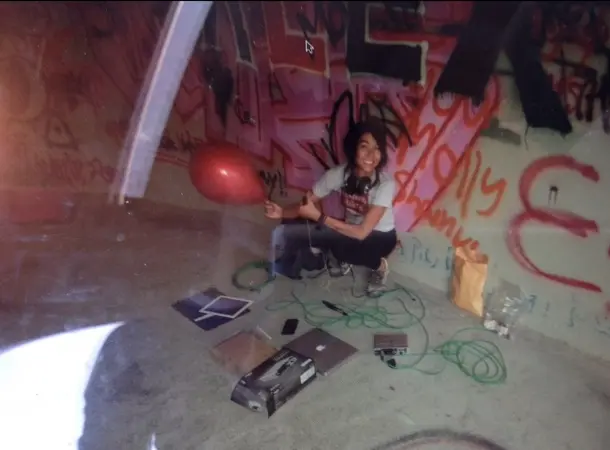
One early strand of the work began with sound: scouting acoustically unusual structures, assisting with measurements, and listening long enough to hear a place change.

One location was known as the Cloud Tunnels—an informal student hideaway with remarkable acoustics. During fog, its one lit entrance could disappear into white and the interior seemed to become part of the cloud.

These were not designed wellness spaces. Respite emerged through institutional permission, a research role, borrowed equipment, and enough uninterrupted time to pay attention. That experience continues to inform Baile's concern with sound, embodiment, access, and learning directly from built environments.

Sahar crouching with a red balloon beside cables and portable audio equipment in a graffiti-covered concrete tunnel
Cloud Tunnels fieldwork · October 2013Preparing the impulse

A balloon, laptop, recorder, interface, and borrowed field equipment assembled inside the tunnel.

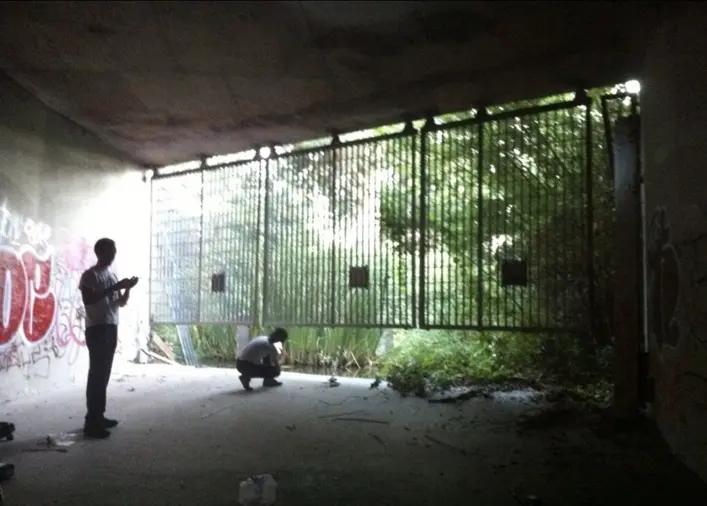
Two researchers positioning equipment inside a concrete tunnel with graffiti, metal fencing, and vegetation beyond
Acoustic location scouting · October 2013Listening to the structure

Hard parallel surfaces, a concrete floor, and a partially enclosed opening produced a long, changing response.

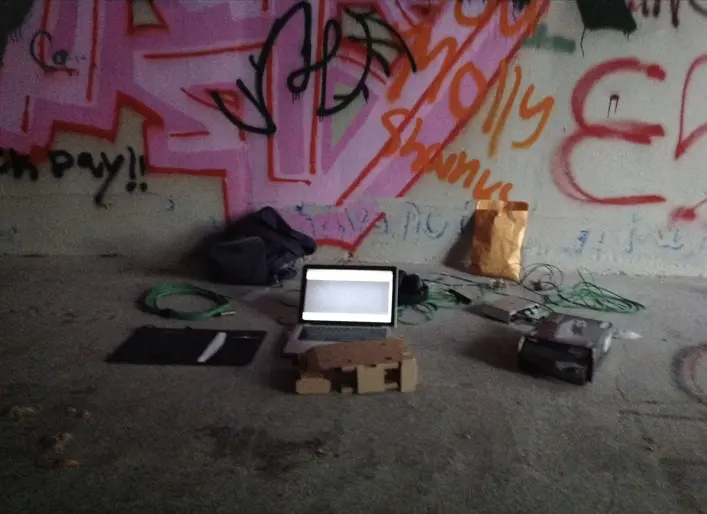
A laptop, portable recorder, cables, cases, and improvised supports arranged on a concrete floor beneath graffiti
Personal archive · October 2013A field laboratory, improvised in place

Professional recording tools did not require a polished laboratory. Careful setup made an overlooked place measurable.

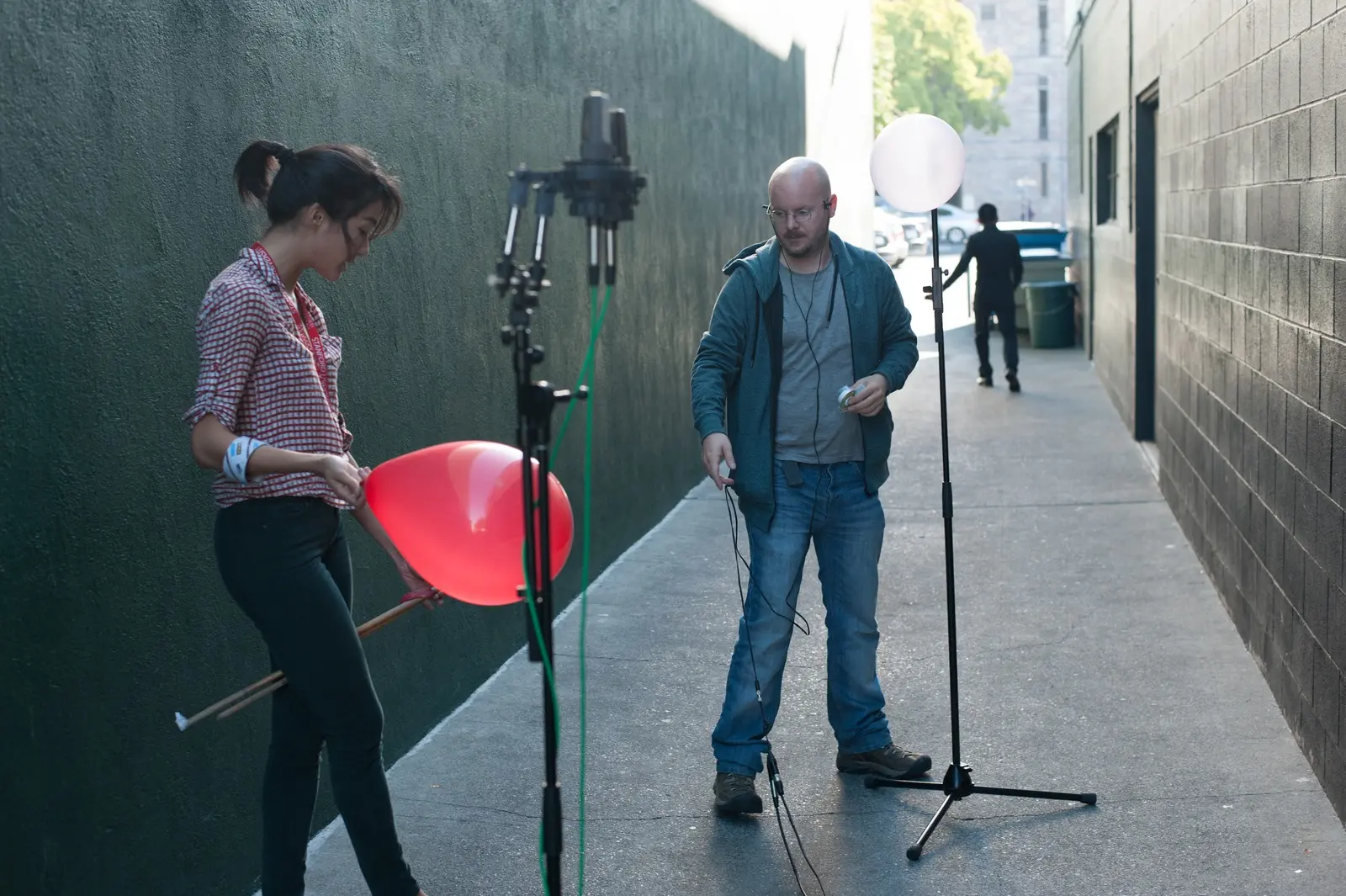
Sahar wearing a Stanford lanyard and preparing a red balloon beside microphones and recording equipment in Mac's Smoke Shop Alley
Mac’s Smoke Shop Alley · photographed 2013, published 2014Fieldwork in the published record

A photograph reproduced in the AES paper documents Sahar assisting with the balloon-pulse and microphone setup.

Selected experience

Practice contexts that have shaped the work.

This is a selective public record. It distinguishes lived and applied contexts from frameworks that remain in development.

2013–2014

Acoustic field research and place-based listening

Stanford CCRMA–connected Icons of Sound fieldwork · Palo Alto, California

Assisted with location scouting, recording setup, and documentation in resonant alleyways and tunnels, using balloon pops, hand claps, microphones, and portable recording equipment to study how sound changed and decayed across overlooked built environments.

2017–2019

Cooperative governance and member systems

Student Cooperative Housing Association · approximately 90 members across seven communities

Board, committee, policy, membership, orientation, accountability, and shared-living systems inside a resident-governed housing cooperative.

2025–present

Cooperative systems and landscape stewardship

The Corner / SCHA · Davis, California

Resident pathways, governance documentation, shared-space systems, ecological observation, stewardship rhythms, and participatory learning.

2024–2025

Survivor-informed research

San Diego State University Research Foundation

Research work shaped by careful handling of lived experience, public systems, recovery, access, and the limits of institutional response.

2025–present

Public ecological learning

Spiral Ecology Experience Dome · Whole Earth Festival

A public installation joining ecological interpretation, materials, volunteer roles, visitor flow, education, and participatory experience.

Selected contexts

Facilitation, education, and interdisciplinary practice

Bosch Bahá’í School · Stanford CCRMA · cooperative and community settings

Embodied learning, cultural inquiry, collaborative making, facilitation, and public-facing knowledge design across varied contexts.

Learning and preparation

Interdisciplinary by necessity.

Formal study, professional training, cooperative education, embodied practice, and situated learning all contribute to the work. Credentials are stated with their present status rather than implied beyond it.

Working principles

Care becomes credible when it has an operating form.

The practice treats transparency, reciprocity, labor recognition, authorship, governance, repair, and ecological attention as mutually reinforcing design requirements.

01

Make the operating layer visible

Roles, handoffs, decision rights, maintenance, attribution, escalation, recovery, and repair are treated as design material—not administrative leftovers.

02

Build participation without extraction

Welcome can be accessible while authority remains connected to orientation, scope, demonstrated care, accountability, and community consent.

03

Let place change the system

Frameworks are adapted through observation of local ecologies, histories, capacities, risks, people, institutions, and accumulated labor.

04

Leave usable structure behind

A good engagement reduces dependence on one charismatic or overextended person by making knowledge teachable, transferable, and appropriately bounded.

Credibility and evidence

Some claims are established. Others still need witnesses.

The site names both: what Sahar can responsibly demonstrate now, and where review, documentation, partnership, or repeated application is still needed.

Credible now

Work that can be shown and situated

  • Original framework architecture and authored public texts
  • Cooperative governance and member-system experience
  • Active stewardship rhythms and ecological observation
  • Facilitation, education, research, and public installation work
  • Working tools, templates, maps, and publication systems

Being earned

Claims that require more evidence

  • Independent specialist review of emerging methods
  • Host-authorized case studies with defined evaluation
  • Documented outcomes across more than one site
  • Confirmed collaborator and participant testimony
  • Clear licensing, access, and adaptation pathways

Authorship and collaboration

Specific contribution deserves specific credit.

The work is collaborative in application without becoming authorless. Clear credit protects the originator, makes participation legible, and helps future users understand which layer came from whom.

Primary authorship

Sahar Tai-Seale

Credited for original framework architecture, naming, authored texts, visual systems, methods, and tools where applicable.

Contribution credit

Named by role

Collaborators, reviewers, facilitators, participants, institutions, and technical specialists are credited for the work they actually contributed.

Local adaptation

Place-specific and visible

Local changes may be named by site, adapter, and year while preserving the authorship and version of the underlying source framework.

Attribution and correction

I aim to distinguish what I developed, what I adapted, what I learned through an established lineage, and what emerged collaboratively. If you recognize a specific practice, phrase, contribution, or source reflected here and believe its attribution is missing or incomplete, please contact me with the relevant history or reference. I welcome good-faith corrections and, where appropriate, conversation about attribution, referral, collaboration, licensing, or paid participation. Resemblance alone does not establish authorship, endorsement, ownership, or authority over the work.

Send an attribution note

Scope and limitations

Frameworks support judgment. They do not replace specialists.

Technical soil assessment, engineering, architecture, legal review, clinical care, environmental compliance, veterinary care, and other regulated or licensed work remain with qualified professionals. Ecological and organizational tools on this site support observation, coordination, learning, and responsible referral.