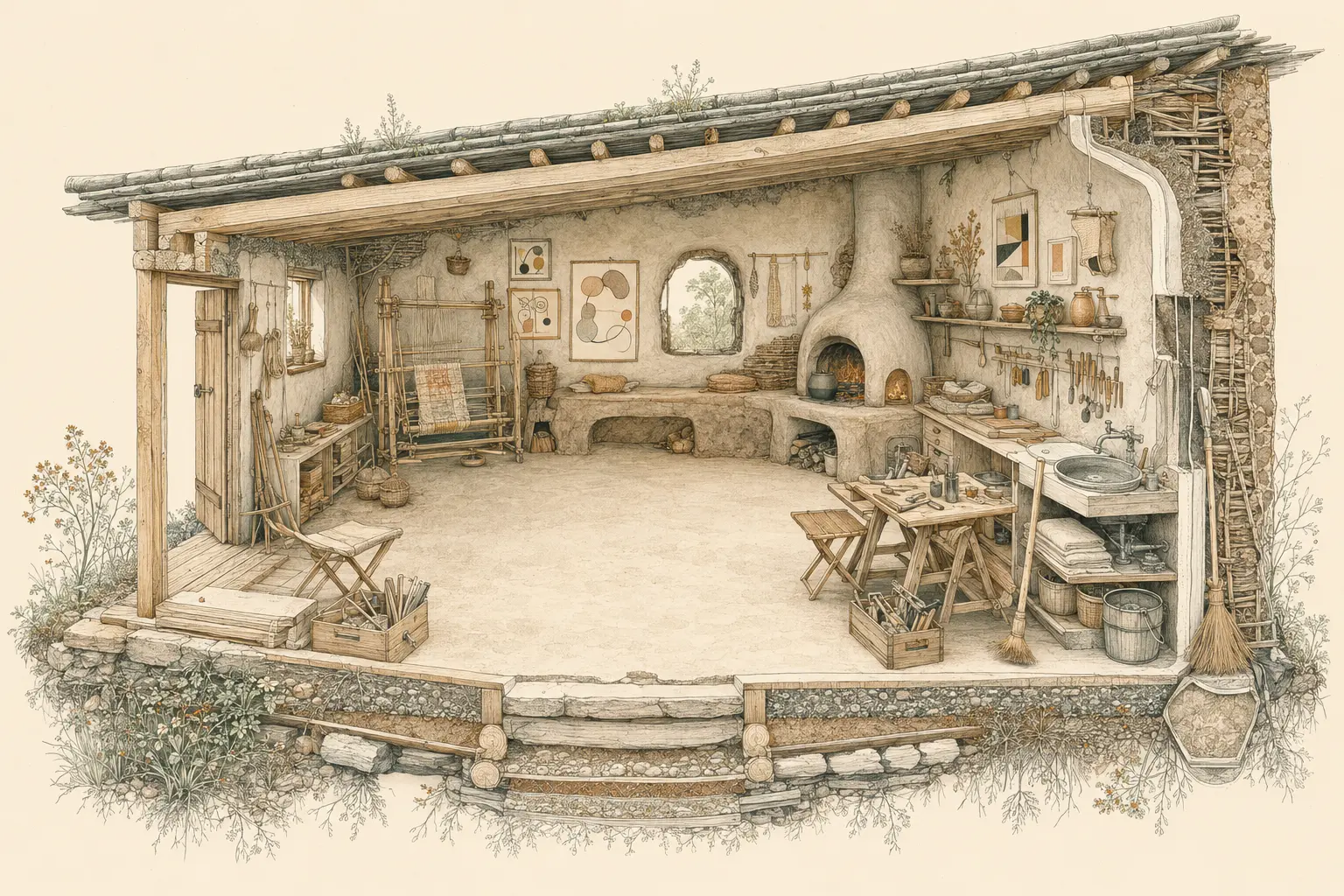
The opposite of inhospitable architecture: places designed to let people pause safely, understand where they are, meet an ordinary human need, and continue with more agency.
The first public proposition is a modular HOW Neighborhood Station—Hospitality, Orientation, and Welcome—held together with a Co-post for materials, water, information, private support, repair, and return paths.
An inhabitable room is not decoration around the service. Shade, water, privacy, tools, maintenance, access, and welcome are the service.
The design reversal
Stop asking how to make people disappear.
Inhospitable architecture asks: How do we prevent someone from staying here? Respite architecture asks: What would help someone pause here safely—and what honest route can open next?
Respite is not a softer bench pasted onto an unchanged system. It is a spatial and operating agreement: someone is responsible for the welcome, the water, the waste stream, the private room, the maintenance, the safety response, and the next-step information.
It should serve neighbors, travelers, workers, students, elders, families, disabled people, people between housing, and anyone who needs a small dignified threshold—without turning every visitor into a client or every need into a spectacle.
One humane arrival sequence
Pause → orient → tend → connect → continue.
A station is useful only if a person can understand it while tired, hurried, overloaded, unfamiliar with the system, or using a different communication mode.
01
Pause
Find shade, seating, water information, a clear route, and enough calm to decide what is needed next.
02
Orient
See what the place offers, who operates it, what is open now, what requires permission, and how to ask for help.
03
Tend
Wash, sort, charge, make a private call, meet an authorized support person, or complete one small act of care.
04
Connect
Reach a real person, service, host, learning route, public office, or community resource without being passed through a maze.
05
Continue
Leave with a reachable next step, a return path, and no requirement to perform gratitude, disclose trauma, or prove future productivity.
HOW Neighborhood Station · modular set
One family of parts. Six different operating jobs.
The modules can share a visual language and arrive as a memorable set without pretending they share one permit, operator, risk level, or maintenance schedule.
That distinction matters. A sign, a seat, a sink, a materials diverter, a private support room, and an overnight bed are not one feature at six sizes. Each creates a different promise and a different duty of care.
HOW
Module 01
Hospitality · Orientation · Welcome
A legible threshold with shade, seating, accessible circulation, multilingual and symbol-supported wayfinding, operating hours, help contacts, and partner-authorized public information.
Before public use
Needs a named operator, daily opening and closing plan, accessibility review, and clear distinction between public information and professional advice.
↻
Module 02
Co-post materials loop
A staffed or supervised place to separate compost, recycling, trash, reusable goods, and repairable materials. A solar-assisted auger or diverter is a study item—not a user-ready machine until engineering, sanitation, lockout, and maintenance review are complete.
Before public use
Needs waste-hauler coordination, contamination controls, safe manual bypass, cleaning, pest management, maintenance ownership, and an ordinary bin option.
⟡
Module 03
Foot-pump rinse + water point
A low-force rinse or wash point that can support reusable containers and basic clean-up while keeping potable, hand-wash, and materials-rinse functions unmistakably separate.
Before public use
Needs plumbing, drainage, backflow, water-quality, slip, reach-range, winterization, and public-health review. Greywater reuse occurs only where approved.
◇
Module 04
Private support room
A small acoustically protected office or conversation hut that an authorized partner could use for case management, benefits navigation, legal help, peer support, telehealth, or licensed care.
Before public use
The room does not make the station a clinic. Each provider remains responsible for credentials, privacy, records, emergency practice, scope, and accessibility.
⌁
Module 05
Laundry + block stewardship
A future partner module could connect laundry access, safe greywater design, landscape care, and an adopt-a-block rhythm without making unpaid cleanup the price of water, clothing, shelter, or belonging.
Before public use
Needs an operator, utility capacity, textile and chemical guidance, approved discharge or reuse, fair labor terms, and a maintenance budget.
✦
Module 06
Visible learning layer
Saturn Lab corridors could turn the station’s solar, water, materials, maintenance, signage, data, craft, and repair systems into accessible STEAM learning rather than hiding how the place works.
Before public use
Learning must never expose private service use or turn people seeking respite into exhibits. Operational data should describe the system, not surveil visitors.
Travel-center forms · Oiko 05 and 06
Pentad by day. Hexagon only when overnight care is real.
The forms are planning mnemonics, not preapproved building types. Adding a sixth side for sleep changes the whole operating system.
05
Day station + office pods
Pentad
A five-part travel or neighborhood center organized around welcome, wash, materials, private support, and stewardship or learning. It closes each day and makes no overnight offer.
Access rule
An operator key controls utilities, storage, records, and maintenance zones. Visitors use public areas; partner staff use scheduled support rooms under their own privacy rules.
06
Overnight hospitality + separate keys
Hexagon
A sixth protected zone adds time-bounded overnight rooms or hostel-style respite to the day-station functions. The added side changes the legal, staffing, fire-safety, privacy, and operating burden substantially.
Access rule
A guest key opens only the assigned personal space for the authorized stay. An operator key remains separate and governed; entry, welfare checks, emergencies, belongings, visitors, and checkout require written rules.
Critical boundary: office pods do not automatically offer therapy, and a hostel form does not automatically offer housing. Providers, operators, eligibility, payment, privacy, life safety, accessibility, emergency response, and exit must be separately real.
A public-benefit braid
Safe streets. Safe homes. Safe food. Safe farms.
These four lanes can meet at one neighborhood threshold while retaining their own funding, professional standards, public authority, and accountability. This is an organizing braid—not the name of an adopted grant or agency program.
01
Safe Streets
Accessible arrival, lighting, crossings, shade, seating, wayfinding, safe parking or drop-off, and a route that does not punish people for pausing.
02
Safe Homes
Protected respite, housing navigation, domestic-violence and trafficking-informed design, private conversation, and overnight space only through separately authorized programs.
03
Safe Food
Potable water, meals or food access through qualified partners, hand-wash facilities, clean surfaces, storage, and food-safety responsibilities that are actually assigned.
04
Safe Farms
Soil, compost, habitat, shade, propagation, greywater where lawful, and stewardship roles that protect ecological health without disguising unpaid labor.
First bounded test
Prototype the welcome before engineering the machine.
The highest-value first pilot is not the most technologically ambitious station. It is the smallest cluster that can prove whether people can arrive, understand, use, maintain, question, and leave it safely.
01
Draw the service ecology
Map users, operators, utilities, waste routes, support partners, maintenance labor, authority, risks, access needs, and what the station must refuse to promise.
02
Mock up one threshold
Use tape, cardboard, signs, movable furniture, and role cards to test reach, turning space, privacy, sightlines, language, decision points, and the work of opening and closing.
03
Pilot the smallest useful cluster
Begin with a non-overnight HOW threshold—shade, seating, clear information, a simple sorting point, and one scheduled partner room—before adding powered machinery, laundry, greywater, or lodging.
Questions worth measuring
Can first-time visitors find the public route and understand what is actually offered?
Can disabled participants use, decline, or modify the experience without extra negotiation?
Does the station reduce contamination, confusion, exposure, waiting, or repeated referrals?
Who performs cleaning, restocking, translation, de-escalation, repair, and closeout—and are they resourced?
What should be changed, removed, moved, or never scaled?
Opening gates
A drawing can be generous. An operating site must be accountable.
No component moves from concept art to public use because it looks wholesome. Every module needs the approvals, people, money, and maintenance appropriate to what it actually does.
01
Resident and intended-user review before the layout is treated as a solution
02
Named landholder, operator, program authority, opening hours, staffing, and emergency responsibility
03
Architecture, engineering, accessibility, planning, building, fire, public-health, sanitation, and utility review as applicable
04
Waste-hauler, plumbing, drainage, greywater, chemical, pest, cleaning, and preventive-maintenance plans
05
Provider-specific privacy, licensure, records, safeguarding, referral, and emergency protocols for any support room
06
Insurance, capital and operating budgets, paid maintenance, fair labor, complaint, repair, data, evaluation, and closure plans
Current invitation
Bring one threshold, not a fantasy city.
A useful next collaboration would choose one real site question, one intended-user group, one operator, and one non-overnight module cluster for a resident-reviewed design table and full-scale mockup.
Respite Architecture, the HOW Neighborhood Station, Co-post, Pentad, and Hexagon are founder-authored working concepts. No site, operator, public agency, service provider, funder, utility, waste hauler, laundromat, housing program, clinical service, or overnight program is represented as committed. This page is not architectural or engineering documentation, a permit set, a service directory, a machine specification, or an offer of therapy, mail, sanitation, laundry, shelter, housing, or land access.