Registered people and vehicles
Safe parking
Overnight vehicle-based respite with sanitation, stewardship, orientation, and referral pathways. This is its own site-specific program—not a catch-all camping permission.
Homeitat™ · public working proposal
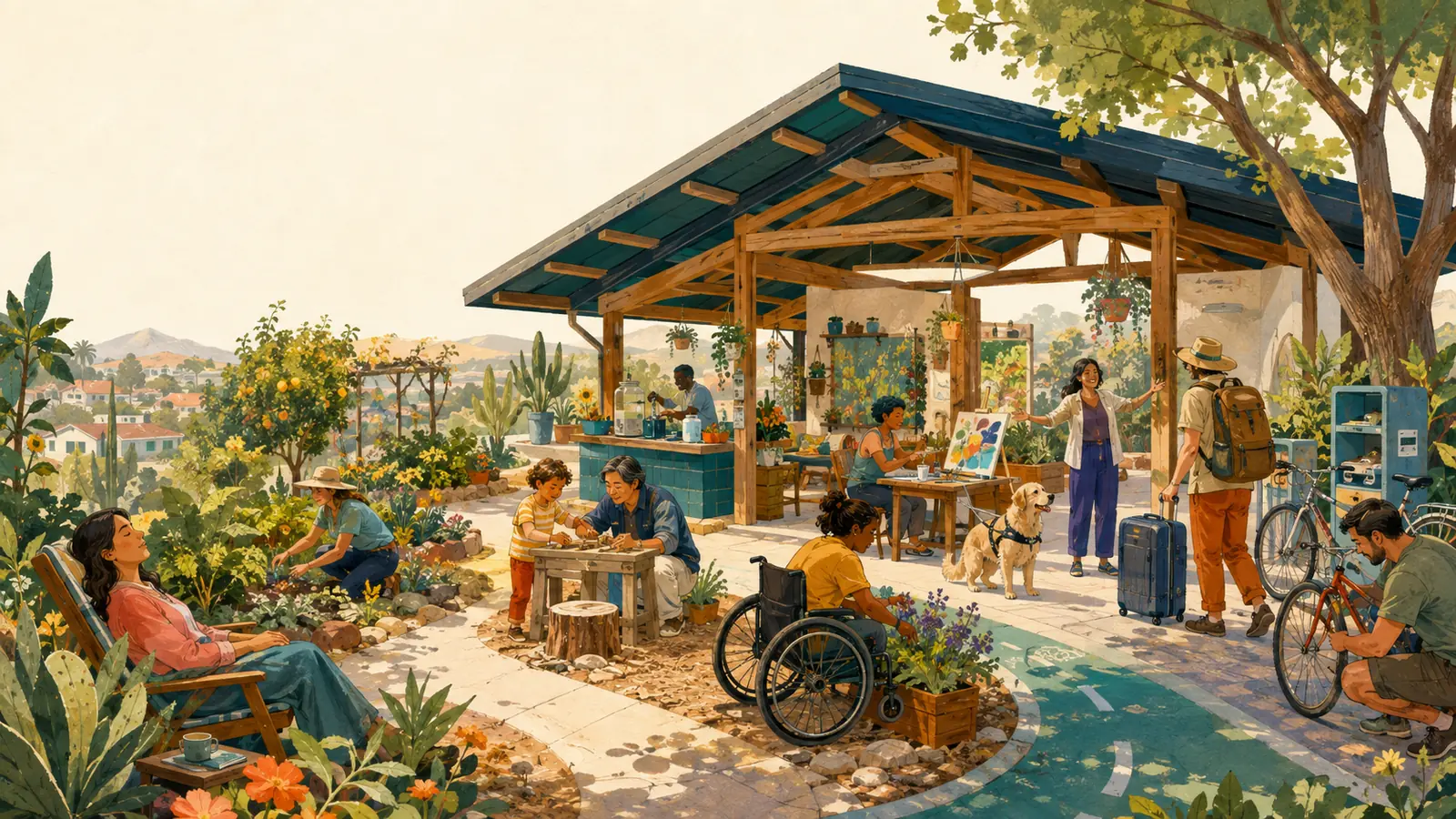
Homeitat Overnight Commons is a proposed family of supervised, low-barrier hospitality pilots connecting safe rest with community learning, play, and stewardship.
People may arrive as travelers, neighbors, students, makers, hosts, or people in transition. Nobody must disclose a diagnosis or perform labor to deserve rest. The atmosphere can feel like camp; the operating structure still has to be adult, legible, funded, and accountable.
The public promise
Rest is not conditional on perfect behavior. Play never overrides consent. Paid work begins where useful work begins. Serious or repeated boundary violations receive proportionate consequences and review.
One family of ideas · no blurry permit
The formats can share learning, visual language, and support relationships. They cannot quietly share permits, staffing assumptions, insurance, or legal authority.
Registered people and vehicles
Overnight vehicle-based respite with sanitation, stewardship, orientation, and referral pathways. This is its own site-specific program—not a catch-all camping permission.
Named event participants
A time-limited college or community event with a defined schedule, supervision, quiet hours, and a clear beginning and ending.
Supervised simulation
A daytime or short-duration lab for practicing orientation, privacy, consent, regulation, and shared-living skills—not informal lodging.
Residential hospitality
A future lodging model requiring building, fire, sanitation, accessibility, staffing, insurance, and guest-management approval before anyone stays overnight.
Safe parking and temporary hospitality do not substitute for affordable housing, permanent supportive services, crisis care, or a housing-focused system of care. They can make the in-and-out experience less ravaging while people pursue durable options.
Hospitality without capture
A welcoming space is not a permissionless space—and a structured space is not an excuse to control people’s lives.
Symbols + words · never color alone
A site map makes expectations visible before conflict. Every symbol is paired with a word and purpose for color-independent wayfinding.
Arrival, orientation, daytime gathering
Supervised tools, projects, paid learning
Registered overnight parking or lodging
Low-sensory regulation without interrogation
Protected, separately programmed use
Relief, decompression, training, companion care
Private peer, clinical, or advocacy conversation
Records, supplies, secure storage, shift handoff
No-camera decision
No body-worn cameras and no routine surveillance cameras are part of the Homeitat model. Optional project photography is limited to clearly announced daytime documentation areas, requires affirmative consent, and stays out of overnight, hygiene, support, and other private zones.
Minimal records
Record only what an authorized operation actually needs: date, time, location, present staff, observable behavior, choices offered, actions taken, known injury or property impact, and any temporary restriction or repair step.
When something goes wrong
Immediate danger receives emergency action. Other situations use a graduated response that protects exits, adds trained support, pauses only the risky activity when possible, and leaves room for review and repair.
Name the observable behavior without diagnosing, humiliating, or inventing a story about the person.
Offer choices: pause, water, food, space, a quiet zone, a peer steward, or voluntary separation.
Add a second trained staff member and protect everyone’s exit routes.
Pause only the risky activity or access level when possible—for example, tools, driving, fire, animal handling, or an overnight guest privilege.
Contact a designated mobile-crisis, medical, advocacy, animal, or licensed-security partner when specialized support is needed.
Use emergency services for overdose, serious injury, fire, imminent violence, a credible weapon threat, or another immediate danger.
Debrief, document minimally, and establish repair, review, appeal, or re-entry steps.
Pilot readiness · before anybody sleeps onsite
Camp counselors, peer stewards, facilities staff, access and animal supports, hosts, licensed partners, and participants need to know who can decide what—and how to get help.
One program type, participant group, duration, capacity, and length of stay are defined.
A willing host, operator, landholder, fund-holder, insurer, and accountable decision-maker are named.
Site permissions, fire and emergency access, sanitation, weather, accessibility, and evacuation requirements are confirmed.
Awake overnight coverage, backups, breaks, paid supervision, and competent training are funded.
Medical, mobile-crisis, advocacy, animal, and emergency response pathways are confirmed before opening.
Complaint, anti-retaliation, exclusion review, repair, re-entry, maintenance, and evaluation processes are tested.
Go / no-go rule
If a program cannot name who is awake, who responds, where someone can regulate, how emergency access works, and how a person can appeal exclusion, it is not ready to host overnight participants.
Paid pilots · informed review · bounded contribution
Homeitat is founder-held work being developed through Sahar Tai-Seale’s independent professional practice. Future institutions and partnerships must be earned through real agreements, paid capacity, and review.
Bring participant, access, legal, insurance, fire, health, animal-care, evaluation, or host-site review.
Register as a reviewer →Identify one bounded room, lot, campus, congregation, park partner, or community site with a responsible host contact.
Discuss a possible site →Fund trained staff, participant stipends, accessibility, sanitation, insurance, tools, materials, maintenance, and evaluation.
Book a scoped conversation →Help test the idea, attend a design workshop, or try an orientation scenario without promising to join a future overnight program.
Follow or participate →Public grounding shelf