Bring a container
A meeting, garden, kitchen, bench, threshold, work party, agreement, conflict process, or other everyday structure that no longer holds what people need from it.
A 75-minute participatory workshop on stewardship cycles for restoring collective spirit in the mucky middle—where communities have left an old structure but cannot yet fully inhabit the next one.
Accepted for the Imagining America National Gathering in Davis, California, October 23–25, 2026. Facilitation materials are in development; this is not an adopted organizational program or policy.
Before the Lantern · Site 0 · 2016
The World of Nature Learning Path joined movement through place, ecological and spiritual inquiry, layered participation, consultation, observation, and iterative user testing.
Housing, a modest annual stipend, mentorship, operational responsibility, self-directed study, and access to an 80-acre conference-center landscape created the original conditions. The later Lantern Method carries that lesson forward while making consent, role clarity, peer belonging, proportional responsibility, and local translation more explicit.
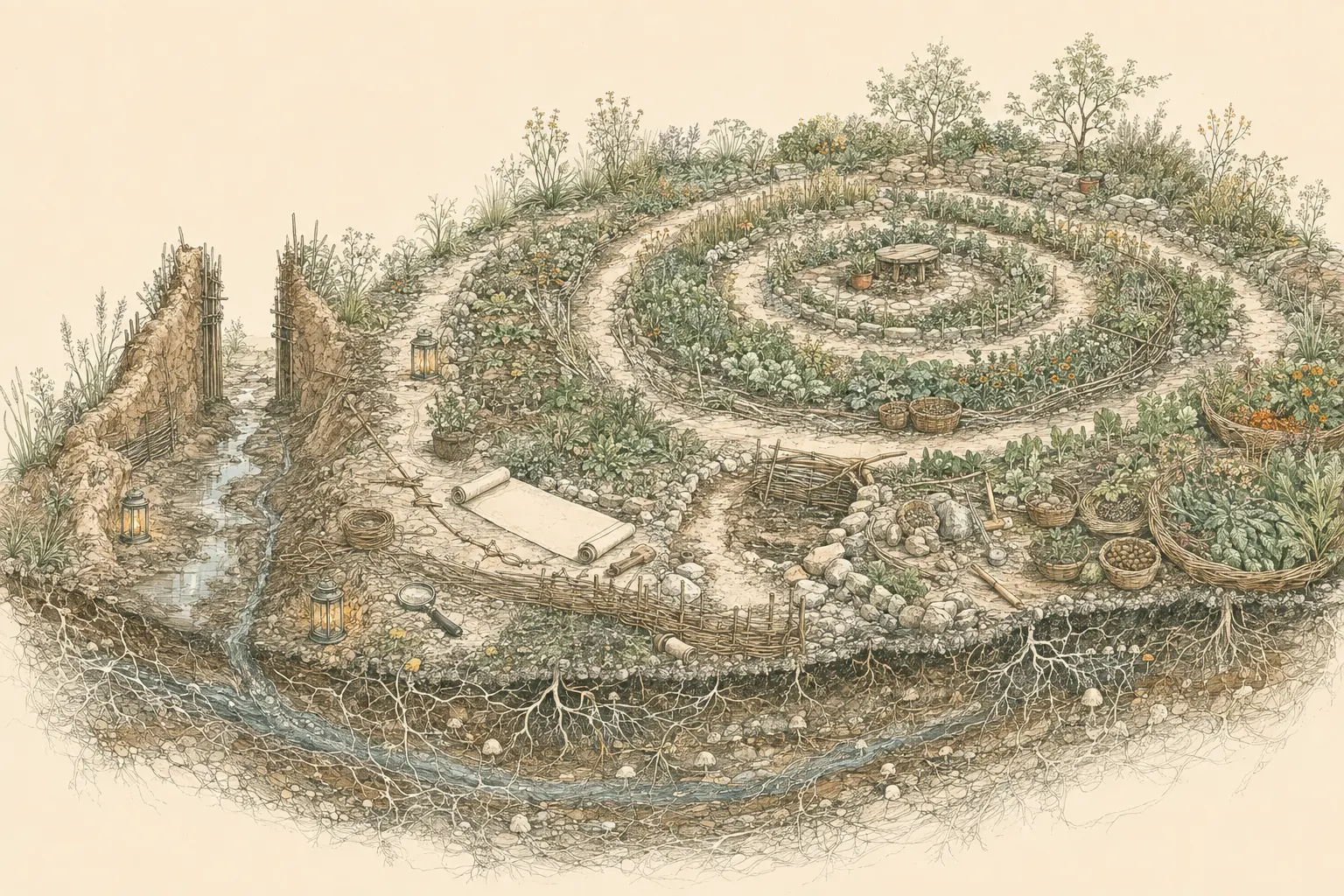
Tides of transition · the mucky middle
The workshop connects arts, humanities, community design, ecological thinking, and cooperative practice. It treats ordinary spaces and repeated practices as places where public scholarship, cultural repair, and institutional change can become tangible.
The walls are still wet. The work is not to pretend the room is finished. It is to make the emerging structure honest, inhabitable, revisable, and capable of holding life.
A four-part stewardship cycle
The cycle supports movement without demanding certainty. Each pass returns experience to the next round of observation so that change can become more intelligent, more accountable, and more alive.
Notice the container as it is: what is alive, what is broken, what people are carrying, and what the place is already trying to become.
Recover the underlying need and its lineage, translate it to local conditions, and shape a response with real thresholds, roles, limits, and support.
Choose a bounded experiment with a steward, permission path, resources, evidence, review date, and a scale that people can actually maintain.
Gather learning, credit labor, name what changed, return useful knowledge to the commons, and let the next cycle begin from somewhere wiser.
Participatory workshop path
Participants do not need to solve their entire organization in seventy-five minutes. They need a practice for seeing more clearly, recovering what matters, and choosing a next step that can be stewarded and reviewed.
A meeting, garden, kitchen, bench, threshold, work party, agreement, conflict process, or other everyday structure that no longer holds what people need from it.
Ask what universal need is present, what specific lineage shaped the existing form, and what a responsible local translation would require now.
Move from a beautiful principle to a supported next action that names permission, care, evidence, boundaries, review, and return.
AACDI · portable design practice
The Art, Architecture & Cooperative Design Initiative supports the workshop’s cultural and spatial inquiry through design-build stewardship, story, art, archives, symbols, communications, design, fair-share practices, craft, trades, and place-making. Its second design proposition—Articulated Harmony + Reverent Emptiness—asks communities to make important relationships visible while leaving enough space for rest, difference, memory, and emergence.
Its original Anarcho-Anachronistic name remains part of the project’s origin story and punk mythology—not its public-facing title.
AACDI is being developed as a portable practice. Any site-based test would be opt-in, limited in duration and scope, host-authorized, and explicit about labor, credit, decision rights, evidence, and review.
Go deeper into AACDIKeep following the work
IA participants and other visitors can register interest in AACDI, the stewardship cycle, a specialist review, a future learning gathering, or one of the larger project rooms.
Follow the LanternThe Spiral Garden commitment
Carry one lantern: a need made legible, a lineage treated with care, a local translation, a named steward, a boundary, a review date, and something useful to return.