01 / Housing & care
Room to
Belong
A proposed Davis housing and care commons: older and disabled adults, humane flexibility, resident power, and dependable support across trusted places.
24 pages · Discussion edition 0.1Möbius Refuge · An invitation to consider
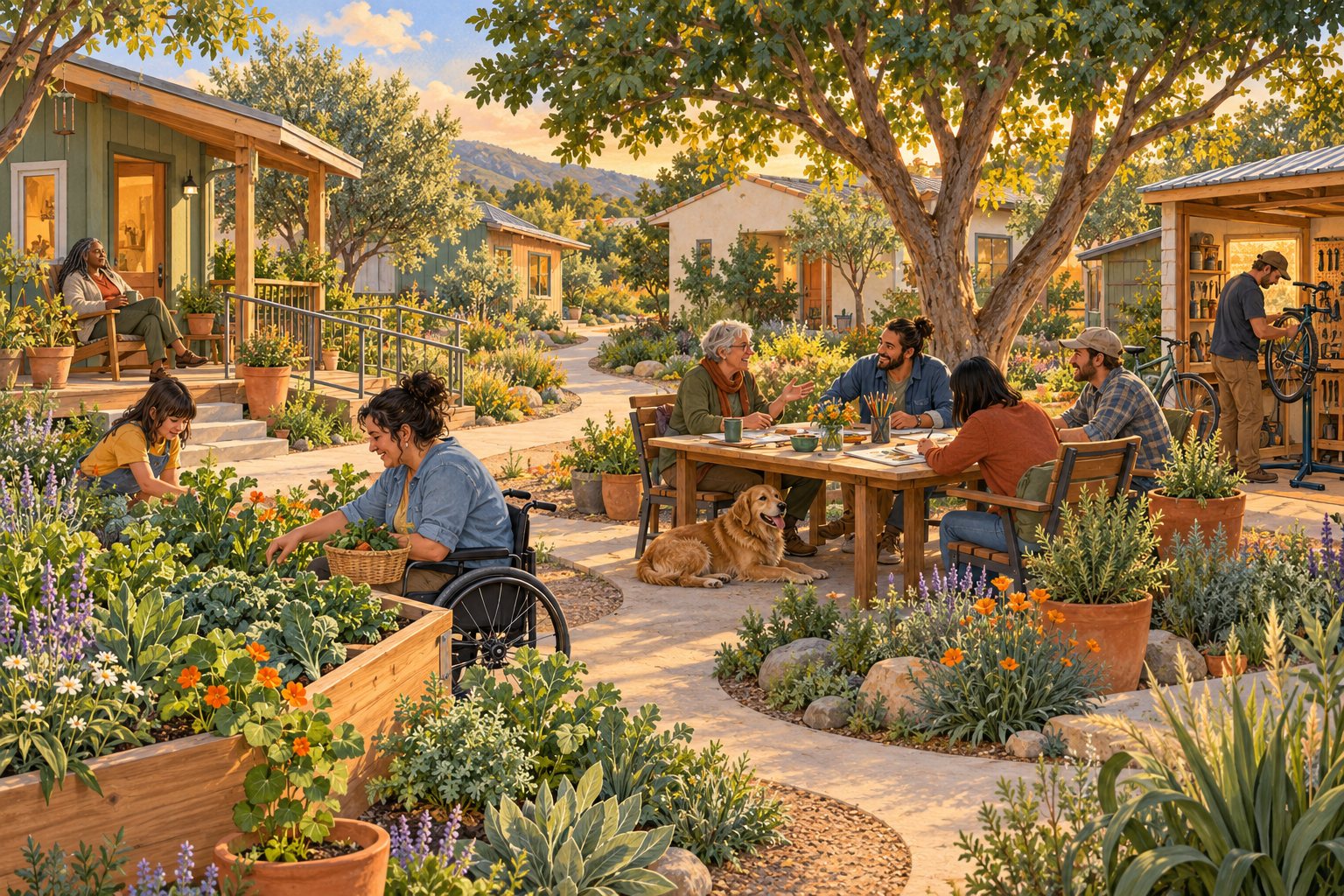
Could a community room or garden make it easier to find a meal, a place to rest, or someone to ask for help? These designs explore what that could look like.
The short introduction
Alongside conversations about safe-camp advocacy and the camping ordinance, this proposal asks whether more small, trusted places could connect people with providers, resources, learning, and meaningful work. Each group would keep its own identity and authority.
A cooperative home, community room, garden, or other suitable host could offer one supported part of a larger network. Representation, consent-based referrals, and resourcing would connect those places.
Commons Camp could bring art, agriculture, and trades into housing, food systems, and transit. Baile, Farmers Matrix, and AACDI offer connected fields of practice, with room for diverse interests and intentions.
Lanterns makes the next step explicit: name the intention, map roles and resources, agree one bounded experiment, and return to learn. The invitation now is to consider whether a small coordination pilot would help the work already underway.
Shared direction, with room for difference. One supported commitment at a time.
New proposal · Seasonal Commons & Local Refugia
A year-round vision for nature, rest, natural building, climate learning, artisan enterprise, and shared stewardship close to home. Three sketches explore how a host might try one activity.
Go deeper when you have time
01 / Housing & care
A proposed Davis housing and care commons: older and disabled adults, humane flexibility, resident power, and dependable support across trusted places.
24 pages · Discussion edition 0.102 / Events, access & alliances
Commons Camp, visiting-provider hours, art and trades, CBPR and ABCD, Bahá’í-inspired consultation, Lanterns responsibilities, and an adaptable pilot card.
21 pages · Discussion edition 0.1Both online editions support continuous scrolling and page-by-page reading. Programs and partnerships remain proposals; site permissions, resources, and capacity must be confirmed before invitations offer services or stays.
A useful meeting outcome
The group’s existing agenda, advocacy strategy, letter, and site decisions remain with its authorized participants. This proposal can support a brief conversation or a separate follow-up.
Roles & responsibilities
Observe → Name → Map → Design → Act together → Document → Return
Every agreement identifies the offer and need, scope, permission, accepted owner, resources and pay, backup, evidence, return date, and a way to step back. Naming a person on a draft does not assign them a role.
Names their own intention, access needs, and sharing choices. Participation and disclosure remain voluntary.
Represents only an agreed constituency and mandate; brings questions and decisions back to that group.
Coordinates one agreed step, confirms willing people and resources, and returns to check what happened.
Holds site permission, access, readiness, conduct response, and closure responsibilities.
Holds the authorized specialist work, supervision, capacity, and follow-up within their scope.
Account for funds, compensation, backup, cleanup, equipment, minimal agreed records, credit, and review.
The blank pilot-card structure may be adapted with credit to Möbius Refuge / Sahar Tai-Seale. Other authored methods, partner names, logos, and branded materials have their own permissions.
Local roots. More doors.
I’m interested in what neighbors, housing cooperatives, mutual-aid groups, and service providers would change in these designs. Who would feel comfortable walking in? What would someone need to know before coming back?
Hospitality and essential support should not depend on volunteering, research participation, religious belief, or public disclosure. The longer vision is unity in diversity, with practical care and accountability.